

Diversity and Distributions | Professors Shaolin Peng and Ting Zhou Reveal the Interactive Effects of Climate and Land-Use Change on Taxus Trees
Science Explained:
Climate change (CC) and land-use/land-cover change (LUCC) are profoundly altering the environments in which plants thrive. Changes in global temperature and precipitation patterns affect whether an area supports plant growth; land-use changes, such as urban expansion, constantly reshape the extent and pattern of habitats. These changes often occur simultaneously, jointly influencing plant survival and distribution. For endangered plants with limited ranges and strict adaptive requirements, these environmental changes may pose even greater survival challenges. The genus Taxus is a prime example; its fossil record dates back to the Early Cretaceous, when dinosaurs still roamed the Earth, making it an ancient plant group that has survived to the present day. It is also an important source of medicinal plants—the well-known anticancer drug paclitaxel was originally isolated from Taxus plants. However, harvesting pressure driven by their medicinal value, coupled with habitat loss and climate change, poses multiple challenges to their survival in the wild. Protecting Taxus plants means not only safeguarding forest biodiversity but also preserving precious genetic and medicinal resources. So, where can they find a permanent home? The study focused on five Taxus species, analyzing climate and land-use changes together and overlaying maps of suitable habitats under past, present, and future scenarios to identify regions that may remain suitable for their survival across time— “long-term refuges.” While these places are not forever safe “safe havens,” they help us identify conservation priorities: safeguarding today’s habitats while also reserving space for the Taxus’ future.
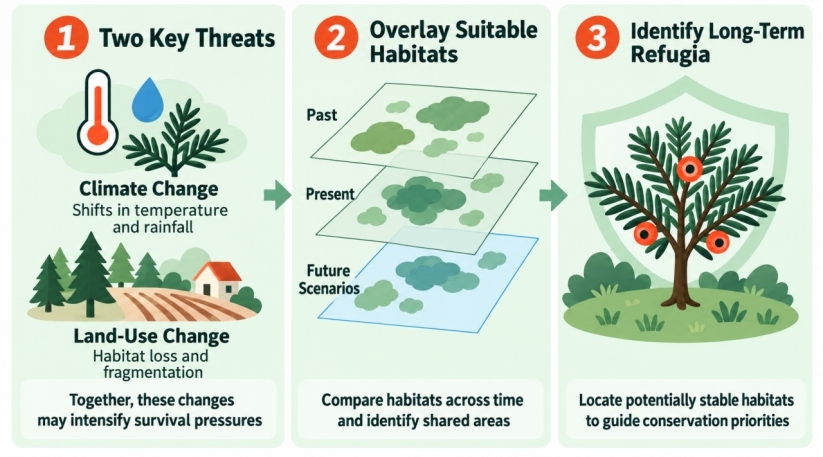
For more information about the article, please see the detailed introduction below:
Using five species of Taxus (Taxus florinii, T. wallichiana, T. mairei, T. chinensis, and T. cuspidata) as study subjects, we developed an integrated “simulation–optimization” modeling framework that couples the Stacked Species Distribution Model (SSDM), the Patch-Generating Land-Use Simulation (PLUS), and the Optimized Geographical Detector (OPGD) (Fig. 1), systematically revealing the independent and synergistic effects of climate change and land-use/land-cover change (CC-LUCC) on the distribution patterns of Taxus species. Future CC-LUCC interaction scenarios exhibit three distinct patterns. The synergistic effect of both factors reduced suitable habitat area by 24% in the southeastern, southern, and northeastern regions (Fig. 2). Taxus chinensis was most severely affected by this interaction, with suitable habitat area loss ranging from 53% to 67%. Independent effects driven primarily by climate change reduced suitable habitat area by 14% in southern Liaoning and Heilongjiang, as well as in Guangxi, Guangdong, and Fujian in South China. Independent effects driven primarily by land-use/land-cover change reduced suitable habitat area by 20% in regions such as Yunnan and Guizhou. Notably, changes in suitable habitat for Taxus florinii and Taxus wallichiana were driven primarily by LUCC, with LUCC-induced losses exceeding those from climate change by more than fivefold.
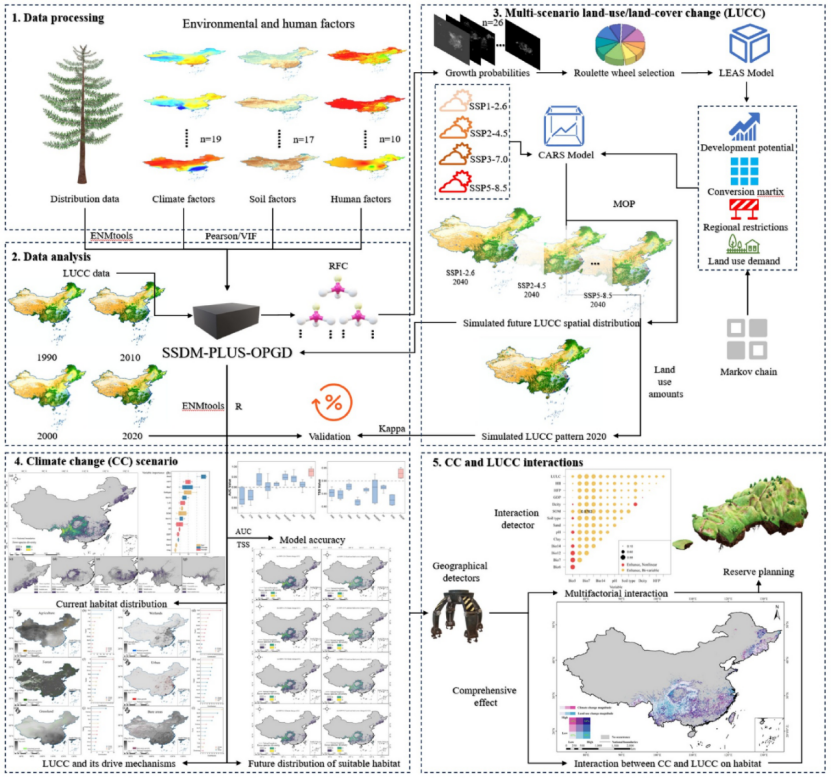
Fig. 1 Coupled SSDM-PLUS-OPGD integrated modeling framework predicting the impact of future CC-LUCC interactions on suitable habitats for target species.
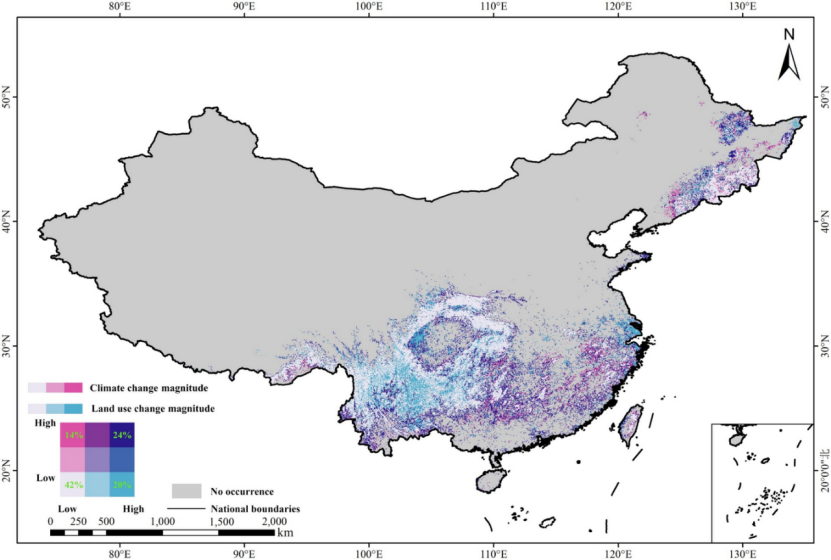
Fig. 2 The comprehensive effect of interannual variation of CC and LUCC on suitable areas from 2020 to 2040.
The study found that from the Last Interglacial (LIG) to the Mid-Holocene (MID), high-biodiversity areas increased, expanding by 42.42 × 10⁴ km². Suitable habitat area also peaked during the Mid-Holocene, reaching 1.4 times the contemporary level (Fig. 3A–Fig. 3H). Habitat loss from the MID to the present has been concentrated primarily in North and South China. Due to the combined effects of climate change (CC) and land-use/land-cover change (LUCC), we found that the area of overlap between historical conditions and current and future scenarios will decrease significantly, with the overlapping area reduced to only 49.59 × 10⁴ km² (Fig. 3I). These overlapping areas are primarily distributed in the mountainous regions of southwestern, southeastern, and northeastern China, which serve as long-term refuges for Taxus. Based on the percentage of overlap between these long-term refuges and protected areas, we further delineated six priority protected areas (Fig. 3J–3O). Furthermore, we found that only 2.89 × 10⁴ km² of these long-term refuges are currently protected, indicating significant gaps in conservation coverage.
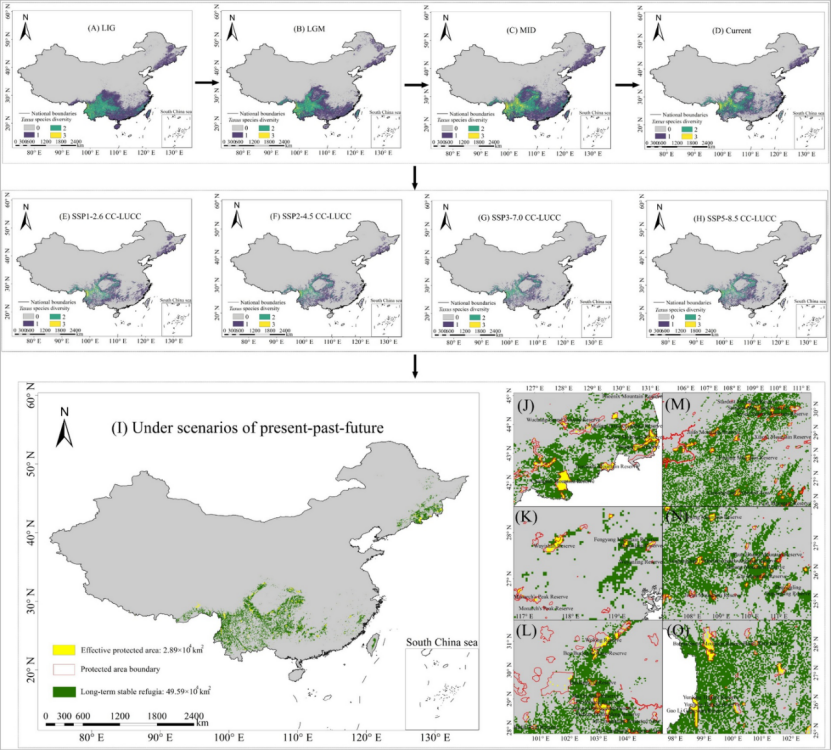
Fig. 3 Long-term refugia and priority conservation areas under future CC-LUCC scenarios. ((A)-(H): Overlapping present-past-future; (l): long-term stable refugia; (J)-(O): Priority conservation areas)
The study, titled “Interactive Effects of Climate and Land Use Change on Taxus Species: An Integrated Modelling Framework for Identifying Long-Term Refugia,” was published in the leading ecology journal Diversity and Distributions. This follows findings by Professor Zhou Ting’s team, published in Industrial Crops and Products (August 2025) and the Journal of Plant Ecology (September 2025), which revealed the impacts of climate change on the distribution of Taxus species and their paclitaxel content. Shuo Zhang, a 2026 Ph.D. graduate (currently a postdoctoral fellow at Peking University), and Yajie Zhou, a graduate student, are the co-first authors of the paper, with Professor Ting Zhou serving as the corresponding author; Postgraduate students Zhuoyi Wu and Xi Long also contributed to this work, which Professor Shaolin Peng supervised. This research was supported by multiple funding programs, including the Fundamental and Interdisciplinary Disciplines Breakthrough Plan of the Ministry of Education of China, Special Foundation for National Science and Technology Basic Resources Investigation of China, and the National Natural Science Foundation of China.
Paper link: https://doi.org/10.1111/ddi.70269

